

From 31 October, householder and one to nine home applications must be decided by officers, and ward councillors lose the power to call them to committee.
From 31 October, if a neighbour applies to extend their house in Henley, or a developer applies for nine homes in Wallingford, no councillor will be able to insist that the decision is taken in public. Both will be decided by a planning officer, and the rules that let a ward member call an application in to committee, or trigger a committee hearing once enough objections arrive, will no longer exist.
That is the effect of The Town and Country Planning (Discharge of Local Planning Authority Functions) (England) Regulations 2026, made on 15 July under section 54 of the Planning and Infrastructure Act 2025 and in force on 31 October 2026. They create a single national scheme of delegation in place of each council’s own rules.
South Oxfordshire and Vale of White Horse have said publicly that they do not want them.
What must now be decided by an officer
Schedule 1 of the Regulations lists the applications that must be delegated. Regulation 4 is not a presumption, it is a requirement. It covers:
- householder development, the extensions, loft conversions and outbuildings that make up most of the district’s planning postbag
- minor commercial development
- minor residential development, defined in the Regulations as a scheme of at least one but not more than nine dwellings on a site smaller than 0.5 hectares
- discharge of conditions, non-material amendments, prior approvals for permitted development, permission in principle, and certificates of lawful development
- reserved matters on any outline permission below 500 dwellings or 50,000 square metres of floorspace
The one exception is an application in which the council, one of its officers or one of its members has an interest. Those can still be referred, on the agreement of the nominated officer and nominated member, without meeting any further test.
What can still reach a committee
Everything else, including major housing schemes, listed building consent, advertisement consent and tree preservation order applications, falls into Schedule 2. There the presumption is still delegation. An application can only be referred to committee if both of the following hold. (Statutory guidance, MHCLG, 1 June 2026)
First, in the view of the nominated member and nominated officer it raises “one or more issues of economic, social or environmental significance to the local area” or “one or more significant planning matters having regard to the development plan and any other material considerations” (regulation 5(3)).
Second, those two people agree. The nominated officer should be the chief planning officer, the nominated member the chair of the planning committee. The guidance is explicit about what happens if they do not agree: “the case must be determined by officers”.
The guidance also narrows the first test with examples. An application that “broadly complies with a detailed site allocation and other relevant policies set out in a local or neighbourhood plan” is unlikely to raise a significant planning matter. Nor is one where a statutory consultee raised a concern and the scheme was then modified to satisfy it.
The two practices that end
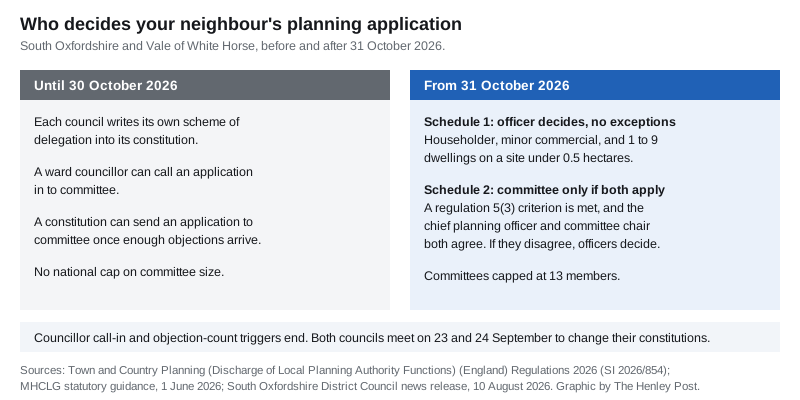
Paragraph 9 of the statutory guidance names the two local habits that stop. “Current practices set out in local authority constitutions, such as the power for ward councillors to require cases to be called in for committee consideration or having trigger points for referral to committee if a certain number of objections is reached, will not be possible.”
Councils that do not amend their constitutions in time are warned that their delegation decisions may be “liable to judicial review”, and that committee decisions taken on applications which should have been delegated “may be subject to judicial review by anyone aggrieved by the decision. This may lead to the quashing of the decision.”
Regulation 7 adds a cap: a planning committee determining an application under the new arrangements “must not comprise more than 13 members”.
There is one gain for the public record. The guidance says councils should keep a record of every case the nominated officer and member considered for referral, the outcome and the reasons, report it to the planning committee regularly, and publish it on their website.
What the councils say
Cllr Tony Worgan, South Oxfordshire’s cabinet member for housing and planning development management, called the changes “a one-size-fits-all approach” and said a “highly standardised system like this could erode the role of our elected members in representing community views and strip councillors of their democratic accountability”.
On the size cap Cllr Worgan said: “We don’t believe committee effectiveness can be determined by size alone. A mandatory cap on committee numbers may make it harder to achieve political balance and geographic representation.” The statement added: “Our hands are now tied as the government enforces these rules across the country.”
Cllr Emily Smith, the Vale of White Horse cabinet member for planning development, put a number on the scale of the change. Cllr Smith said “well over 95 per cent” of applications are already decided by officers, that the Vale’s committee hears “around the 30-40 most complex and contentious applications” a year, and that under the new scheme “around 3/4 of applications that committee have heard in recent years would not have come to us”.
Both councils hold special meetings to change their constitutions: the Vale on 23 September and South Oxfordshire on 24 September.
What it means for you
Objecting in numbers no longer buys a hearing. A petition of 200 names cannot force a committee under the new rules, and neither can your district councillor. What can is a specific, policy-based case put to the case officer, because the referral test is written in planning terms: significance to the local area, or a significant planning matter against the development plan.
Your neighbourhood plan is now worth more, not less. The test works both ways. An application that fits a detailed allocation in a local or neighbourhood plan is flagged in the guidance as unlikely to merit committee. A departure from one is the clearest available route to the opposite conclusion.
Small schemes are now officer decisions, full stop. Nine homes on a plot of under half a hectare is the ceiling. That is the size of a great many infill schemes in the villages between Henley, Watlington and Thame.
Watch the referral log. Once the councils publish the record of what was considered for committee and refused, that list is the fastest way to see how the new test is being applied here.
The changes do not affect the Benson application for up to 170 homes, which is a major application in Schedule 2 and could still be referred. We list decisions across the district on our Henley planning news page.
Have your say