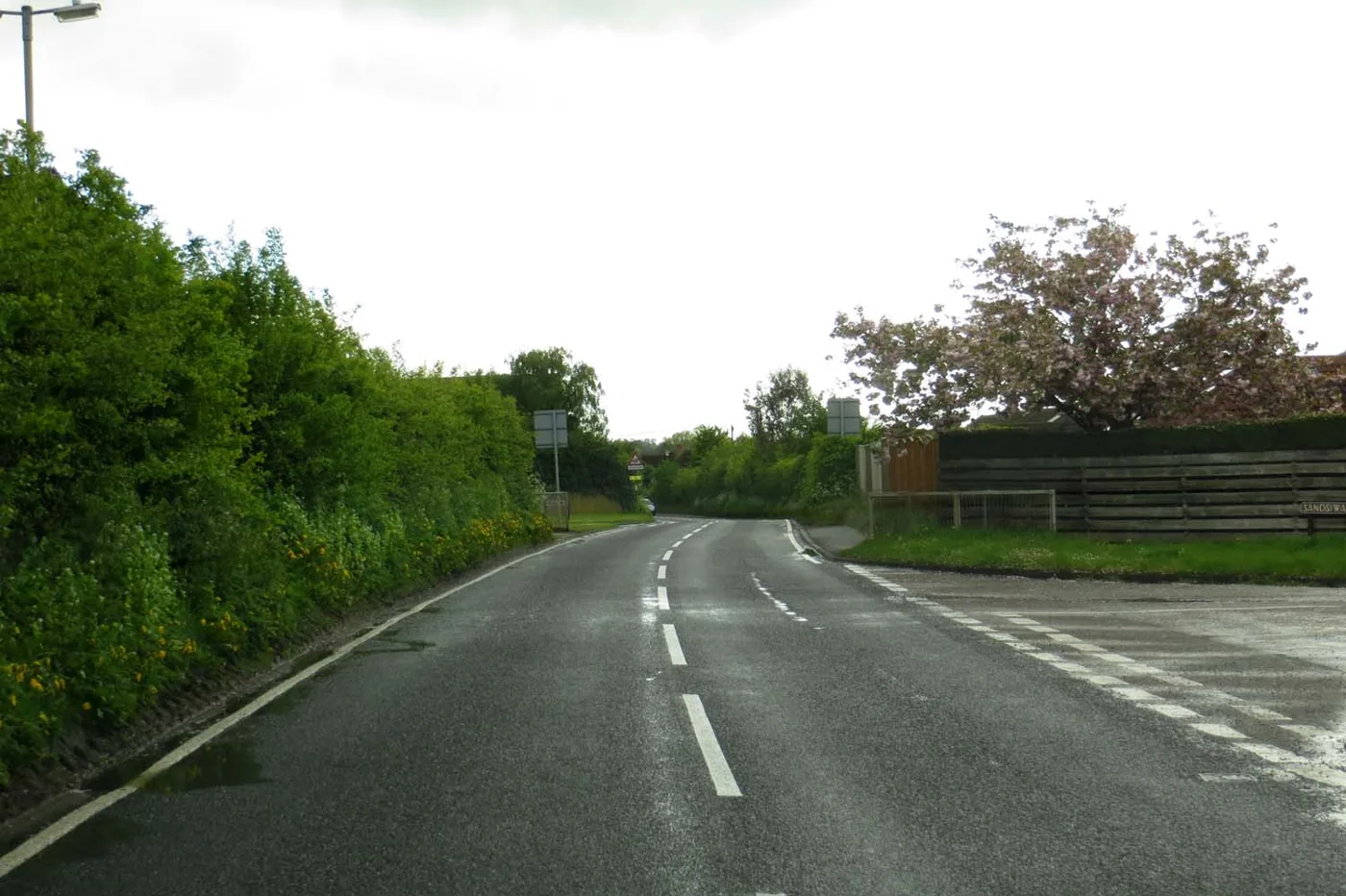

Elivia Homes wants up to 170 houses on the Watlington Road field where the Secretary of State refused 120 in 2018. The parish council objects. Ref P26/S1811/O.
A housebuilder has applied to put up to 170 homes on the field on the south side of Watlington Road in Benson, and Benson Parish Council has told South Oxfordshire District Council it objects strongly. It is the same field on which a Secretary of State refused 120 homes eight years ago, against the recommendation of his own inspector.
The application is P26/S1811/O, an outline application for “up to 170 dwellings with all matters (except access) reserved” on land south of Watlington Road. The council’s own weekly list records it as valid on 26 May 2026 and categorises it as major development. The applicant is Elivia Homes (Central) Ltd of Woodlands Court, Beaconsfield, and the case officer is Emma Bowerman on 01235 422600.
Outline means the layout, scale, appearance and landscaping are not being decided now. Access is, which is why the parish council has spent most of its objection on the junction.
What the parish council actually said
The council’s response, dated 26 July and published on 30 July, is a document rather than a press release, and its specific points are more useful than its adjectives.
On height. The applicant’s Building Heights Parameter Plan, the parish council says, “clearly envisages ridge heights of up to 10.5 metres (slightly disingenuously described as 9.5m +/- 1.0m)”. It sets that against Principle C1 of Appendix B to the Benson Neighbourhood Plan, which reads: “All new built development should maintain a low profile with standard provision for two storeys or less.”
On the hedge. To provide visibility splays for vehicles leaving the site, the council says the applicant proposes to remove most of the long-standing field hedge on the south side of Watlington Road and cut the rest, and any replacement, to 0.5 metres high along the whole frontage.
On the access. The junction would be, on the parish council’s count, the eleventh on the short stretch between the site and Castle Square, and would sit a few metres from the lower chicane near Sands Way. The council’s argument is not that traffic would be heavy but that the geometry would push drivers the wrong way: turning left through the village centre is easier than crossing a queue to turn right for the relief road roundabout about 150 yards away.
On the transport assessment. The parish council points out that the routes the applicant offers for cycling to Wallingford School and Wallingford town centre run along the Thames Path, and that the Benson to Shillingford section of the path is a no-cycling section. It calls this “one of many” misconceptions and says it “demonstrates the limitations of desk research when designing routes”.
On scale. The council states that Benson has seen 831 new dwellings built since 2018, of which 565 were allocated in its neighbourhood plan, a 62 per cent increase on an existing stock of 1,350 dwellings in eight years. It says the relief road originally planned to open fully in 2024 is now unlikely to open before summer 2027, and that parents are already being refused places at Wallingford School.
That 831 is not only the parish council’s number. The same total appears, measured a different way, in a planning inspector’s decision on another Benson site five months ago, below.
The last time this field was decided
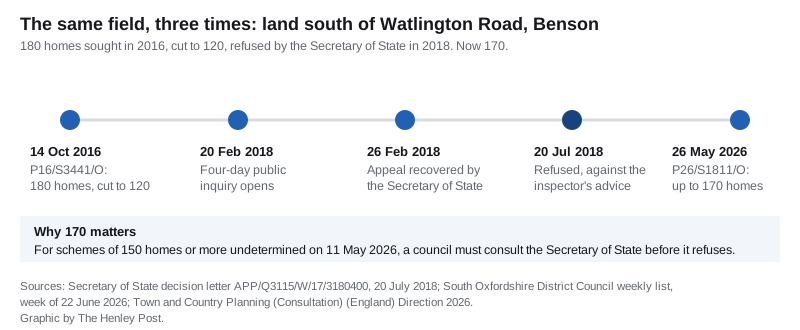
In October 2016 the same field was the subject of application P16/S3441/O, made for up to 180 dwellings and reduced to 120 during the application. South Oxfordshire refused it, the applicant appealed, an inspector held a four-day inquiry from 20 February 2018, and the appeal was recovered for the Secretary of State’s own determination six days later.
The inspector recommended that permission be granted. On 20 July 2018 the Secretary of State refused it anyway, and the reason he gave matters now. He found the scheme conflicted with Policies G2, G4 and NP1, gave “significant weight” to the housing and affordable housing it would deliver and “moderate weight” to the local economic benefit, and then set against that the conflict with the Benson Neighbourhood Plan, to which he gave “very significant weight”. (Decision letter, APP/Q3115/W/17/3180400)
The new application is for 50 more homes than the one that was refused, on the same land.
What has changed since 2018
Two things, and they pull in opposite directions.
The first is the district’s housing land supply, and the clearest public statement of it is a Benson decision from this March. An inspector dismissed an appeal by Beechcroft Developments for 40 age-restricted homes on land next to The Orchard, Braze Lane, after an inquiry in February. (APP/Q3115/W/25/3374232, decision)
In dismissing it, inspector S Wilkinson recorded that South Oxfordshire “has not been able to demonstrate a five year supply for several years”, and that on the council’s own primary case the figure is 3.81 years, or 3.64 years on its secondary position. A shortfall like that is the standard argument for granting permission on unallocated land.
That is a worse position than the one the council last published itself. Its own statement, at a base date of 1 April 2025, put the district at 4.46 years. The lower figures are the council’s case at the inquiry this February, after the revised national method raised the requirement to 6,484 homes for 2026 to 2031.
The same decision, though, put the other side of it on the record. The inspector noted that the local plan expected Benson to take 440 additional dwellings, that its neighbourhood plan requirement was 561, and that 831 dwellings were actually allocated in the plan. Those figures, he wrote, “are not to be regarded as a ‘cap’ on future supply” but “reflect the positive engagement of the local community through the planning process. This is a matter of considerable importance.” He gave the neighbourhood plan policies substantial weight and dismissed the appeal.
The second change is procedural, and it is the reason the number 170 is worth noticing.
The 150 rule
On 23 March 2026 the government announced, in a written ministerial statement, that councils would have to consult ministers before refusing large housing schemes. The Town and Country Planning (Consultation) (England) Direction 2026 was made on 31 March. Its wording is short:
It applies to any application for development including 150 or more houses, flats or houses and flats that had not been determined before 11 May 2026. Where a council proposes to refuse such an application, “the authority must consult the Secretary of State before determining the application”, and a footnote to the Direction confirms the council must then wait at least 21 days before deciding, while ministers consider whether to call the application in.
The Housing Minister, Matthew Pennycook, confirmed the measure in the Chief Planner’s newsletter of 27 March, which said it would “enable Ministers to decide whether to use their existing powers to call in that planning application”. (MHCLG planning newsletter, 27 March 2026)
Benson Parish Council’s reading is blunt: it says the 170 figure “reflects the applicants’ aim to ensure that the application, if SODC is minded to refuse, is referred to the Secretary of State”. That is the parish council’s inference about the applicant’s motive, not a fact on the file. What is on the file is the arithmetic: 170 is above 150, this application was undetermined on 11 May 2026, and so a refusal by South Oxfordshire cannot be issued without going to London first.
What it means for you
Comments still go to the district council, not the parish. Use the council’s find and comment on a planning application page, which leads to the new online register, and search for P26/S1811/O. The register is new this year and the council’s own banner warns that “some features may not be working as expected”, so if the search fails, the case officer’s number is 01235 422600.
A comment that names a policy carries further than one that does not. Both decisions above turned on the neighbourhood plan rather than on general objection: the Secretary of State gave the plan very significant weight in 2018, and the inspector gave it substantial weight in March. Points about access, height and landscape, tied to a policy, are the ones that appear in decision letters.
The parish council is collecting views separately. It says it will “collate all the responses and use these in any future discussions with authorities”. That is useful to it, but it is not the same as commenting on the application, and only the second reaches the file the case officer reads.
If this is decided at committee, watch the timing. A refusal now triggers a mandatory 21-day pause while ministers decide whether to take the decision away from South Oxfordshire. An approval does not.
We track decisions across the district on our Henley planning news page, and what building at this rate has done to prices is in our house prices guide, where the middle Henley-on-Thames home sold for £600,000 over the last twelve months and the middle Wallingford home for £430,000.
Have your say