

Councillors approved the change on 24 September. From 31 October a ward councillor has seven days after consultation closes to ask for a committee hearing.
South Oxfordshire District Council has rewritten its rules on who decides planning applications, and the old call-in is gone. Councillors approved the changes at a special meeting on Thursday 24 September. They take effect on 31 October 2026.
The council did not want to do it. Its own announcement, published on Monday 28 September, is headed “Councils reluctantly approve constitution changes”. The changes are required by new national rules, the Town and Country Planning (Discharge of Local Planning Authority Functions) (England) Regulations 2026. We explained what those rules do in August: South Oxfordshire planning: officers decide from 31 October.
What is new is how South Oxfordshire will run them. The council report sets out the process, and it is narrower than many people will expect.
What stops on 31 October
The report spells out what falls away. From 31 October, these can no longer send an application to the Planning Committee:
- a ward councillor calling it in
- an objection from a town or parish council
- any other automatic committee trigger in the current rules
This includes applications already in the system. The report says the change applies to “any call in on applications which are not yet determined by that date”. So a call-in made today on an application that is still undecided on 31 October no longer counts.
Householder extensions, schemes of one to nine homes and minor commercial work must be decided by officers. That is a national requirement and the council has no choice over it.
The new route to a committee hearing
For everything else, including major housing schemes, listed building consent, tree works and adverts, the starting point is still an officer decision. The council has added a step the national rules allow: the Gateway Referral Request.
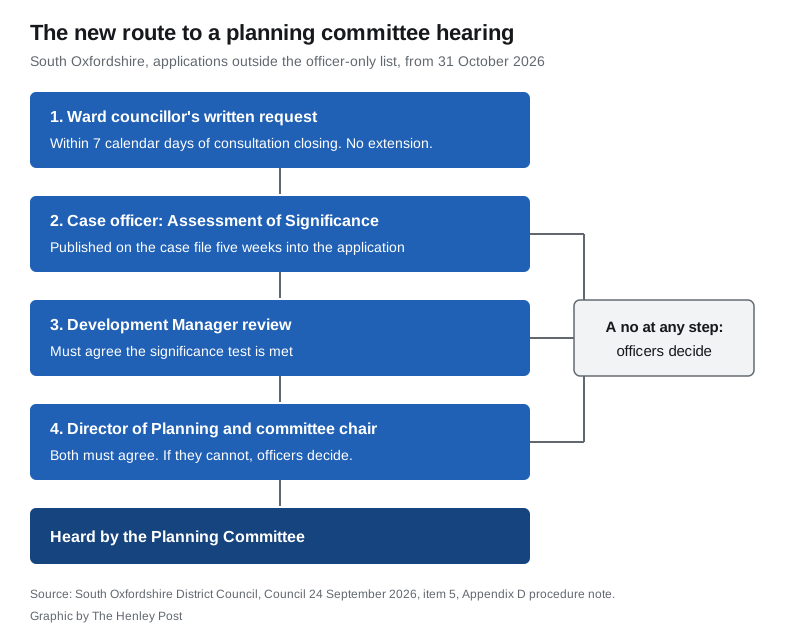
According to the council’s procedure note, the request must:
- be made in writing by a ward councillor for the area the application is in
- explain how the scheme meets the legal test of significance
- arrive no later than seven calendar days after the public consultation closes
- come from a councillor with no interest in the application
The note says plainly that the seven days “shall not be extended”.
The legal test is whether the scheme raises issues of economic, social or environmental significance to the local area, or significant planning matters under the local plan.
A request then has to clear three people in turn:
- The case officer writes an Assessment of Significance. If they find the test is not met, it stops there.
- A Development Manager reviews it. Again, a no ends it.
- The Director of Planning and the Planning Committee chair decide together. Under the national rules, if they cannot agree, officers decide the application.
A request does not bind anyone. The note says the decision “remains a matter for the nominated officer and relevant nominated member”. The council confirmed the committee chair as that member, with the vice chair as substitute, for the rest of this municipal year.
What residents and parish councils can still do
Residents, parish and town councils and amenity societies can still comment on any application. Officers must consider anything that is a material planning matter. Where an application does reach committee, those groups keep their right to speak at the meeting.
The council will also publish more than before:
- each Assessment of Significance, on the case file, five weeks into the application
- each gateway decision, online, before the application is decided
- a list of the delegated decisions made after referral meetings
What the cabinet member said
Cllr Ben Higgins, cabinet member for planning development management, said the changes “take power away from locally elected representatives at both parish and district level and are the opposite of devolution”.
He said that under the existing rules, the committee passed “the vast majority of applications for residential dwellings when applications were referred”. The changes “will make at best a marginal difference in the number of homes built, at a significant cost to local accountability,” he said.
The report gives the council’s reason for going along with it. Without the changes its arrangements would break the law, and decisions on the officer-only applications could be unlawful. Planning decisions that ignore the new rules risk being quashed by judicial review.
The council has not yet published the minutes of the 24 September meeting, so how councillors voted is not on the public record. Its announcement says only that the changes were approved “after a lengthy debate”.
What it means for you
If you object to a neighbour’s extension, nothing about your right to comment changes. But no councillor can now take it to committee. An officer will decide it.
If you sit on a parish or town council, your objection is still weighed, but it no longer triggers a committee hearing. If you want a large scheme heard in public, ask your district ward councillor early. The request window shuts seven days after consultation closes.
If something big is planned near you, watch the case file five weeks in. That is when the officer’s Assessment of Significance should appear.
If you have an application in the system now, a call-in made before 31 October lapses if no decision has been made by then. The Planning Committee meets on 7 October and 26 October before the switch. To check the status of an application, see our Henley planning news page.
Sources
- Councils reluctantly approve constitution changes for new planning process, South Oxfordshire District Council, 28 September 2026, for the approval, the 23 and 24 September meetings and Cllr Higgins’s comments.
- Council, 24 September 2026, agenda item 5: Constitution Update, National Scheme of Delegation for Planning, report of the Director of Planning, for the recommendations, the nominated member, the end of call-ins, the effect on undecided applications and the legal risks.
- Appendix D, Procedure Note: Decision-Making Arrangements under the National Scheme of Delegation, for the Gateway Referral Request, the seven-day deadline, the three-stage assessment and the publication timetable.
- South Oxfordshire Planning Committee meetings, 2026, for the 7 and 26 October meeting dates.
Have your say