
Three would-be drivers for FISH in Sonning Common pulled out over the cost of a D1 licence. A minister told their MP a cheaper route is under review.
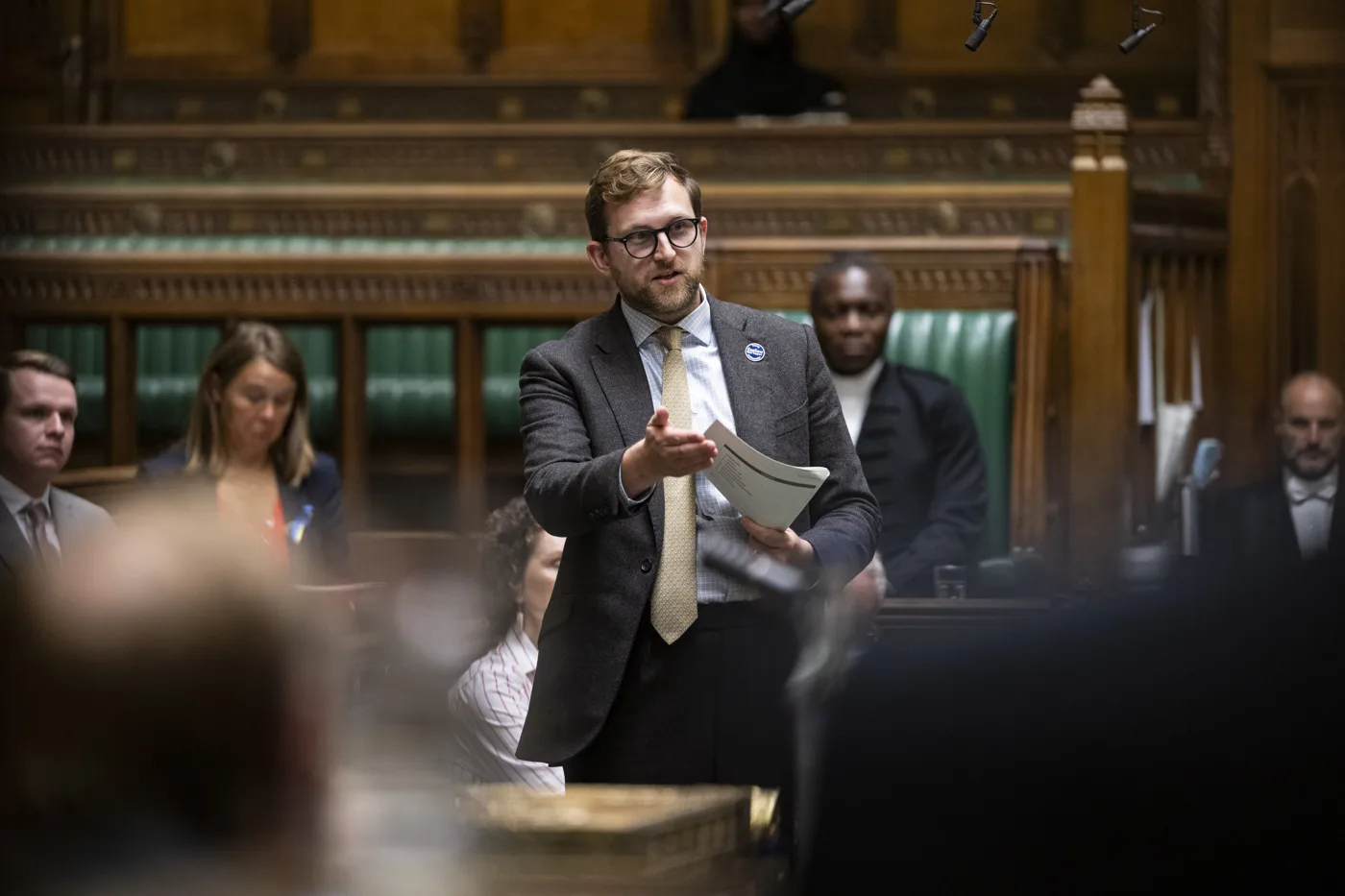
Three people who offered to drive the volunteer minibus in Sonning Common all withdrew when they found out what it would take to get the licence, MP Freddie van Mierlo told the House of Commons on Tuesday night. They pulled out even though Sonning Common health centre had offered free medical checks to volunteer minibus drivers.
The story of FISH, which stands for Friends in Sickness and Health, opened a debate van Mierlo led on 3 November about the rules for minibus drivers. He wants them changed before community transport in places like Henley and Thame runs out of people to drive it. The minister who replied said the government is actively reviewing a proposal for a cheaper route, but made no commitment to change the law.
Why the drivers are running out
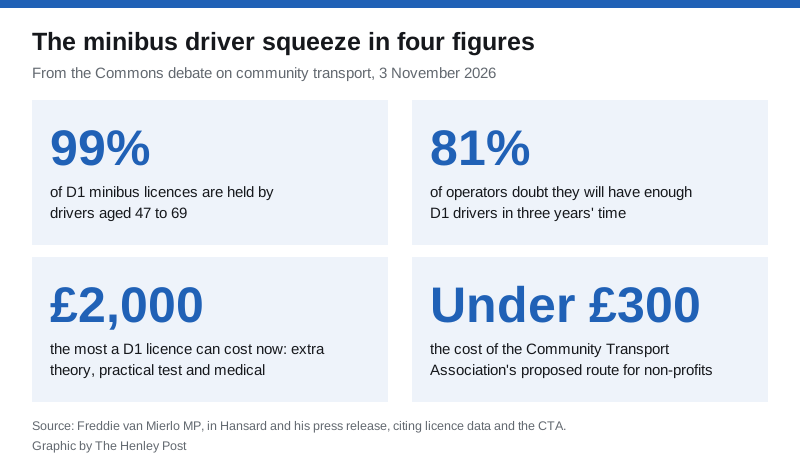
Anyone who passed a car test before 1 January 1997 was automatically given the right to drive a minibus, as long as it was not for hire or reward. Anyone passing since needs a separate category D1 entitlement, which means an additional theory test, a practical test and a medical assessment. Van Mierlo’s office puts the cost at almost £2,000, and he told MPs it runs up to that figure.
After 70, a D1 licence has to be renewed every three years with a further form and a medical. The result, according to van Mierlo’s release, which cites Great Britain’s driving licence data, is that 99% of people holding a D1 licence are aged between 47 and 69, and that band shrinks every year. The Community Transport Association, which represents more than 1,300 services, gives the same picture on its campaign page with a slightly different band, 46 to 69.
Van Mierlo told MPs that more than 3 million D1 licences are likely to be lost in the next five years as their holders reach 70, about one in five of the total. The association’s own figure is more than 2.9 million, or 21%.
What FISH says
FISH runs a free, volunteer-led service for residents of Sonning Common and the surrounding villages. Its minibus has a wheelchair lift and does weekly shopping trips and leisure outings, and its volunteers also run a door-to-door service for medical appointments. The charity says it receives no public grants.
John Pearman, who coordinates its transport, and chairman David Whitehead met van Mierlo at Westminster in October. Between them, the MP told the Commons, they coordinate half a dozen drivers.
“During my time at FISH volunteer centre, people have expressed interest in joining the minibus driver team, however many of them withdraw interest when they realise the additional cost and time needed to update their license to D1 status,” Pearman said.
“An organisation like FISH relies on the help of volunteers to carry out essential transport for local people, and is frustrating when barriers to minibus licences prevent them from getting involved.”
It is not only Sonning Common. In the debate van Mierlo also named Henley HandyBus, supported by Henley Town Council and running daily, and the Woodcote Volunteers, who provide transport to their monthly tea parties.
What the MP wants
“It’s obviously right that we want drivers of minibuses to be safe and to pass some additional requirements, but this should be as smooth and easy process as possible,” van Mierlo said. “We shouldn’t be throwing up barriers to people who have good intentions and want to put back into their communities through community transport.”
“In rural communities like Henley and Thame, volunteer and community transport are essential. These are areas where a commercial, for-profit bus service are never going to be viable, so unless we want to replace volunteer run services with heavily tax-payer subsidised services we really need to be thinking harder about how to help them, not hinder them.”
More than half of community transport operators already report too few D1 drivers to meet demand, he said, and 81% are not confident they will have enough to sustain their services in three years’ time, a figure he attributed in the Commons to the association.
“The government has expressed interest in solving more everyday issues. Here’s one that needs fixing, and there’s time to do it,” he said. “I’m raising this now, because we don’t want to get into a position in a few years time where this vital resource has collapsed completely - not through lack of community support, but because of national red tape.”
The association’s proposal, which he asked the minister about, is not a return to the pre-1997 rules. It would let drivers gain a D1 licence for driving for non-profit organisations through a training-based upgrade accredited by the Driver and Vehicle Standards Agency, with an online theory test, a short practical session, and on-road and medical assessments. He said that would cost under £300. He added that he is no road expert and that the plan may not be the whole answer.
What the minister said
Simon Lightwood, a transport minister, could not resist a pun on the charity’s name: “I pay tribute to FISH, in this plaice, for doing a fantastic job.”
On the licence he accepted the problem. Drivers with the old automatic entitlement are getting older and their number is falling, and he recognised the argument that the cost of a D1 may be particularly challenging for small, not-for-profit groups. Of the association’s proposal he said: “The Department is aware of that proposal and we are actively reviewing it.”
He would not go further than that. “Road and passenger safety must remain at the heart of our consideration of any changes to the licensing regime,” he said. In 2025, he told MPs, 3,069 D1 tests were taken, 2,511 were passed and 552 failed.
The previous government’s 2022 call for evidence drew 2,061 responses. Of the 2,052 people and organisations who answered the question, 73% supported removing the D1 test, including 31% who wanted added conditions, and 23% did not. Lightwood said that support was not the same as evidence the change would be safe, and that the department did not think the evidence was enough to assess the road safety risk. The association disagrees.
The association says the exemptions the government points to do not go far enough. They let post-1997 drivers take a minibus of up to 3.5 tonnes, and he told MPs that nearly three quarters of the community transport fleet are minibuses with between 9 and 16 seats, often weighed down with accessibility equipment.
The minister also listed what the government does now: an annual grant to the association and up to £3.8 million a year through the bus service operators grant, with a 60% uplift on community transport claims until 31 March 2027. He said operators carry around 13.8 million passenger journeys a year; van Mierlo’s release says more than 16 million passengers rely on them.
What it means for you
Nothing changes yet, and no date was given for a decision.
If you passed your car test before 1 January 1997, you are in the group these services rely on, so it is worth checking whether your licence shows the D1 entitlement. FISH can be reached on 0118 972 3986 or at office@fishvolunteercentre.org.uk, and its website has details of how to support it.
The full exchange is in Hansard.
Have your say