
Eleven premises on Market Place, Bell Street and Hart Street have been empty for over a year. Cabinet is asked on 26 November not to force lettings yet.
Eleven shop and business premises in Henley town centre have stood empty for more than a year, South Oxfordshire District Council has found. They are on Market Place, Bell Street and Hart Street.
The figure is in a report to the council’s Cabinet on Thursday 26 November. It asks councillors not to use new powers to force landlords to let empty shops, for now.
How Henley compares
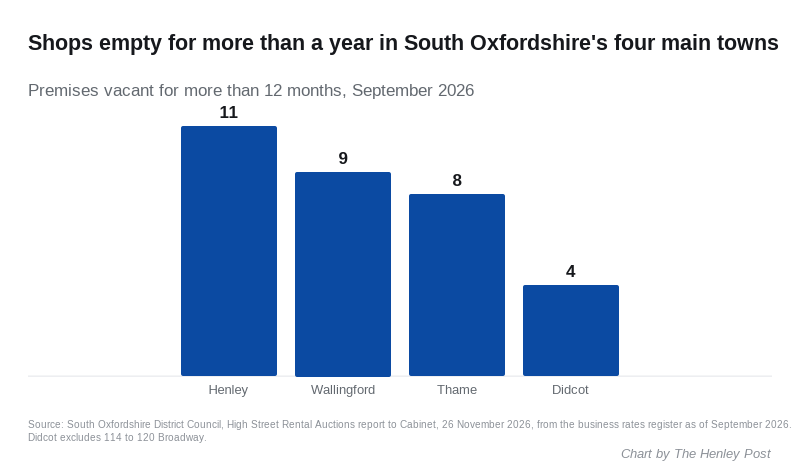
Officers checked the council’s business rates register in September 2026 for premises empty for more than 12 months. The report found:
| Town centre | Premises empty over a year | Share of town centre premises |
|---|---|---|
| Henley | 11, on Market Place, Bell Street and Hart Street | 4.37% |
| Wallingford | 9, on St Martins Street, St Mary’s Street and Market Place | 6.9% |
| Thame | 8, on Cornmarket, Buttermarket and High Street | 5.8% |
| Didcot | 4, on the Broadway | 2.23% |
The Didcot count leaves out 114 to 120 Broadway, which the council is redeveloping itself.
These are not the towns’ full vacancy rates. The report says the overall rate “will be greater”, because it also includes premises empty for less than a year.
For comparison, the report puts the UK average vacancy rate at between 12% and 17% in recent years. Below 10% is generally seen as healthy, it says.
The council’s property team describes the district’s retail market as “generally stable”. It says demand is focused on Henley, Thame, Wallingford and Didcot, with low vacancy in the best locations and strong independent shops.
What the new powers are
High Street Rental Auctions came in under the Levelling Up and Regeneration Act 2023. They let a council require a landlord to rent out a shop that has been empty for a year, or for 366 days in two years.
The process, as the report sets out:
- the council designates the street as a high street, after at least 28 days of consultation
- the landlord gets a 10 to 12 week notice period, and can avoid an auction by letting the premises
- if not, the council auctions a lease of the premises over 12 weeks
- a landlord who ignores requests for information without reasonable excuse can be fined up to £2,500
The government says pilot councils have helped bring more than 60 units back into use, often without an auction, the report adds.
What the council is being asked to do
Officers recommend Option B. The council would treat the auctions as a tool for the future, and do limited early work: updating property information and identifying target areas.
Alongside that, officers would cost other ideas:
- town centre partnerships with town councils, to find tenants for problem units
- small grants for shopfronts, signs, lighting and basic fit-out
- a “meanwhile spaces” programme for pop-up and seasonal shops and creative spaces
Officers say they could not run auctions with current staff. The government pays £5,223 per auction, which the report says would not cover the cost. A new £10 million government fund for the auctions opens to bids on 23 November.
Cllr Leigh Rawlins is the cabinet member responsible. Any spending would go through the council’s budget for 2027/28.
What it means for you
Nothing changes on Henley’s high street yet. If Cabinet agrees on 26 November, the council starts by contacting owners of long-empty premises rather than auctioning them.
The meeting is at Abbey House in Abingdon at 6pm. Anyone can register to speak by emailing democratic.services@southandvale.gov.uk by noon on the working day before.
Sources
- High Street Rental Auctions, report to South Oxfordshire District Council Cabinet, 26 November 2026, agenda item 9, for every figure, the recommendation and the process.
- South Oxfordshire District Council meetings calendar, for the meeting time, venue and how to register to speak.
Have your say